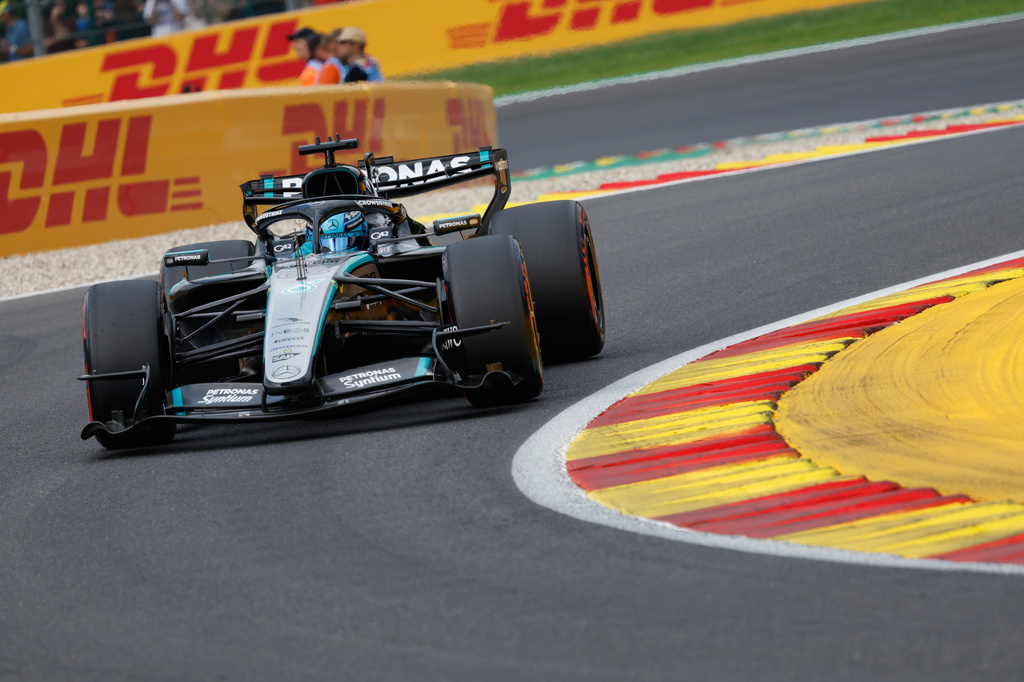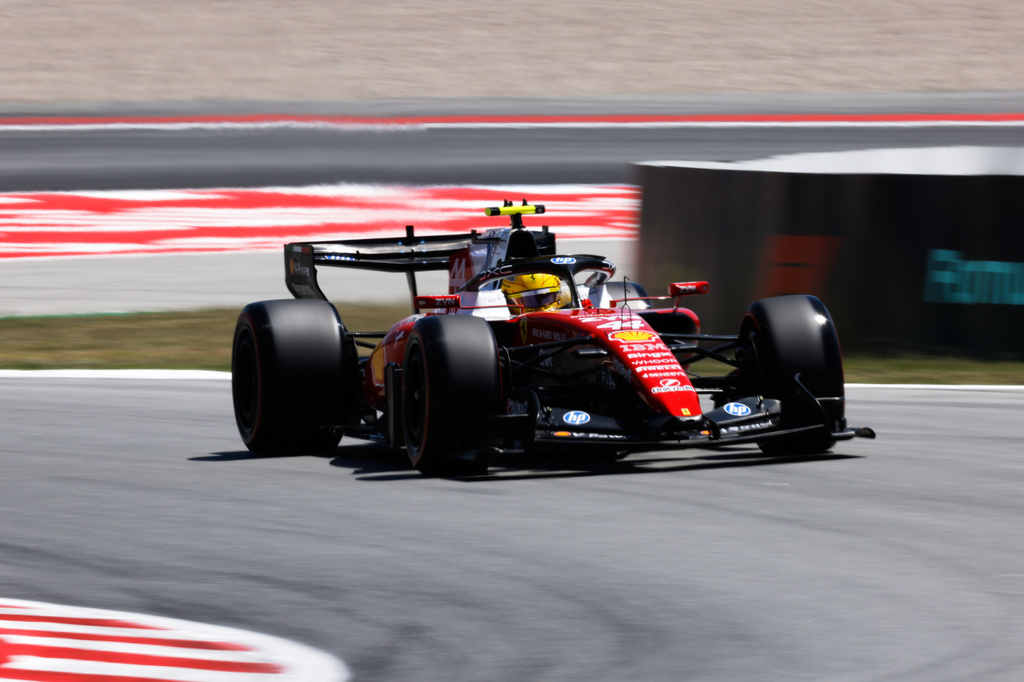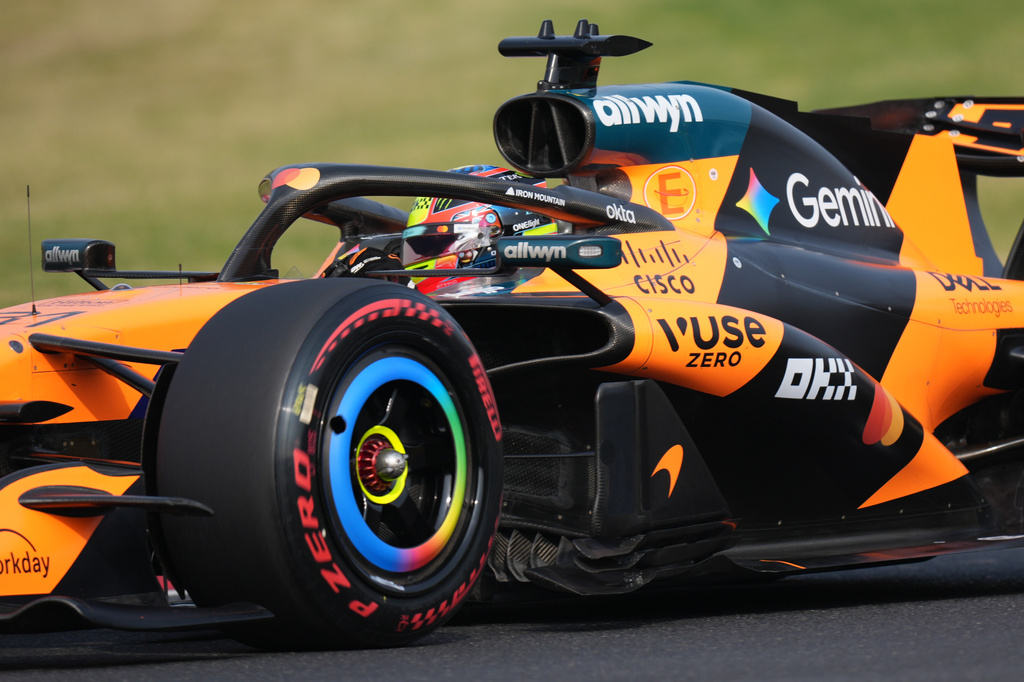

Formula 1 qualifying sets the starting grid and gives fans the first real look at who has pace for race day.
Across Q1, Q2, and Q3, F1 drivers battle to put down their fastest lap, avoid elimination, and lock in the best starting spot possible in qualifying. The higher a driver qualifies, the cleaner their path usually is on Sunday.
For F1 predictions on PrizePicks, qualifying is one of the best data points to help predict what we’ll get on race day, which can help shape your F1 picks.
Below, we’ll explain how F1 qualifying works for every race and what qualifying results can tell us before race day.
Make your F1 predictions on PrizePicks for every race — including qualifying positions, winner, and more
{{f1_offer_banner="/style-system/ui-components-playbook"}}
How Does F1 Qualifying Work? Format, Sessions, & Starting Grid
F1 qualifying is what decides the starting grid for the Grand Prix. Drivers run timed laps across three elimination rounds — Q1, Q2, and Q3 — with the fastest driver in Q3 taking pole position.
Formula 1 qualifying is the race before the race, giving F1 fans an intriguing adventure before hitting the track on Sunday. In addition, it’s provides a plethora of insights for the race.
What Is F1 Qualifying? & Why It Matters
F1 qualifying determines where each driver starts the race. That matters because track position is a big part of Formula 1. Starting near the front usually means cleaner air, fewer cars to pass, and more control over race strategy.
Qualifying and, ultimately, the several practice sessions, have a huge impact in F1, especially if you’re making race predictions.
The reason is simple: these on-track performances are one of the best ways to determine the form of drivers and teams heading into the race on Sunday.
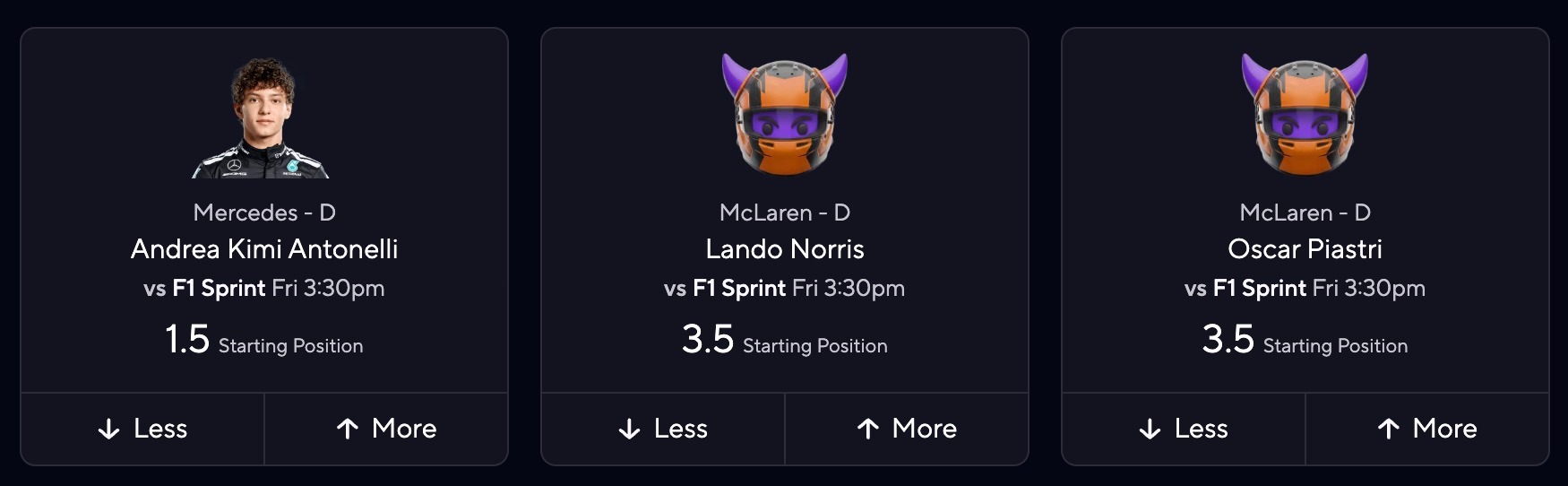
Qualifying position markets are offered by PrizePicks, for drivers to qualify More or Less than their projected position. Knowing how the starting grid takes shape helps in building Lineups for the race and more.
Make your F1 predictions on PrizePicks on qualifying, race winners, podium finishes, and more.
2026 F1 Qualifying Format, Explained
In a standard F1 weekend, qualifying is split into three sessions: Q1, Q2, and Q3. The slowest drivers are eliminated after Q1 and Q2, and the fastest 10 drivers fight for pole position in Q3.
Q1 — The First Elimination Round
Typically, Q1 — the first qualifying session — is the first make-or-break for every F1 race. All 22 drivers have 18 minutes to get their best lap in. The slowest six are eliminated and start at the back of the grid
If a driver posts one of the six slowest times, they are eliminated for future qualifying rounds.
Q1 lap times can be a little slower than later qualifying sessions, as the track is still evolving and top teams may only need to do enough to advance.
However, drivers still need to clear the 107% rule: their Q1 time generally must be within 107% of the fastest lap in Q1 to qualify for the race.
Q1 can get chaotic late as drivers look for clean air, avoid traffic, and try to finish their final push lap before any yellow or red flags risk interrupting the session.
Q2 — The Field Narrows
In Q2 — the second qualifying session, the 16 remaining drivers have 15 minutes to set their fastest lap, making multiple runs during the session.
Once the clock hits zero, the six drivers with the slowest best laps are eliminated and will fill starting positions 11-16, leaving just 10 drivers for Q3.
While the push to get into the Top 10 is important, those in positions 11-16 can freely determine their tire strategy at the start of the race.
Q2 is where teams usually have to be more precise. Drivers need enough tire grip, clean air, and track space to put together a strong lap.
The same chaotic nature of the final minutes is there, with a bit more urgency, especially as the seconds dwindle.
Make F1 qualifying position predictions on PrizePicks
Q3 — Pole Position Shootout
After a shorter break between Q2 and Q3 to ensure qualifying is still one hour long, Q3 is the final qualifying session for every F1 race.
The top 10 drivers who advanced from Q2 have 13 minutes to turn in their fastest lap. For the top teams, this is the session that matters most, as it determines the starting grid up front.
The quickest around the course in their best lap gets the pole position.
Pole position typically gives a driver the best chance to set the tone for the race. Clean air is paramount for early track position. Also, pit stop windows can be changed or altered with a bit more ease. Depending on the track, it can allow a leader to pit and come out with minimal or no loss of position.
PrizePicks qualifying position markets center here the most heavily, as this is the last time the cars are seen in their quickest, performance-pushing form.
Formula 1 Sprint Qualifying: How Sprint Qualifying Works
Sprint weekends change the normal F1 schedule on a few weekends during the season. Sprint Qualifying sets the grid for the Sprint, while regular qualifying sets the grid for the Grand Prix.
An F1 sprint is a shorter race, typically held the day before the main Grand Prix. It is usually around 100km, which is much shorter than the full Sunday race. Sprints are in addition to the main race — not replacing it, giving drivers a chance to score points before the Grand Prix.
In 2026, F1 sprints are featured in Shanghai, Miami, Montreal, Silverstone, Zandvoort, and Singapore.
Sprint Qualifying works like a shorter version of regular qualifying. Drivers go through SQ1, SQ2, and SQ3, but the sessions last 12, 10, and 8 minutes instead of 18, 15, and 13, giving drivers a limited time to make their fastest lap.
In 2026, with 22 cars on the grid, the slowest six drivers are eliminated after SQ1, and the next slowest six are eliminated after SQ2. The fastest 10 drivers move on to SQ3, where they fight for Sprint pole.
Saturday features the normal qualifying format, but first, there is the 100km sprint with no pit stops. Points are awarded for the Top 8 positions in the sprint race; Grand Prix races still award points to the Top 10 finishers.
{{f1_offer_banner="/style-system/ui-components-playbook"}}
F1 Practice Sessions & Why They Actually Matter for Predictions
Practice sessions do not set the starting grid, but they still matter. They give teams time to test the car, adjust setup, check tire wear, and see how the car performs in different conditions.
For fans making F1 predictions on PrizePicks, practice can help add context before qualifying and race day, so long as you’re locked into practice.
On a standard F1 weekend, there are three practice sessions: FP1, FP2, and FP3. On Sprint weekends, the schedule changes. Teams usually get only one practice session before Sprint Qualifying and the Sprint race.
A second twist is practice tire strategy. Teams are only allowed 20 sets of tires for the entire race weekend. Tire choices in qualifying and practice carry consequences.
Balance is the most difficult to negotiate for F1 teams. Not all tire compounds are created equal. Depending on the track conditions, getting the tire right is so crucial. Timing and track position become vital, too.
Sending drivers out when conditions are optimal can make an immense difference in qualifying and practice. Strategy matters especially for your F1 predictions on PrizePicks.
F1 Practice Sessions: FP1, FP2, and FP3 & What Each Session Tells You
Each F1 practice session is normally 60 minutes long. FP1 is the first test of the weekend, held on Friday morning; Drivers learn the track conditions, test upgrades, check car balance, and give teams early data to work with.
Meanwhile, FP2 — usually Friday afternoon local time — is about race simulation, making it the most useful for race predictions. Drivers and teams will find out what their cars are like on short and some longer runs alike.
Gauging pace is essential in this session, as opposed to just overall practice speed. This can give a better idea of which cars may be strong on Sunday.
FP3 is the final practice session before qualifying. Teams use it to make last setup changes and focus more on short-run pace before Q1, Q2, and Q3.
On Sprint weekends, FP2 and FP3 are replaced by sprint qualifying and the sprint race, so teams have less time to dial in the car, which can make Sprint weekends more unpredictable.
Using F1 Practice Lap Times to Make F1 Predictions
Raw practice times can be deceptive. Teams may be using different tires, fuel loads, engine modes, or run plans. A driver at the top of the practice results might be on a low-fuel run, while another driver lower down could be focused on race pace.
Instead of only looking at the fastest lap, pay attention to:
- Sector times: Which drivers are fast in specific parts of the track?
- Long-run pace: Who stays consistent over multiple laps?
- Tire wear: Who keeps speed without burning through tires?
- Teammate gaps: Is one driver clearly faster than the other in the same car?
- Track conditions: Did a driver set their lap when the track was faster or slower?
Look toward the sector times on practices. Teams add and dump fuel all over the place during the practice sessions to get a better read on their cars.
It is okay to gloss over raw practice times because they can be that deceptive. A lighter car runs faster, and a heavier car runs slower — much like a warmed-up tire and colder tires. Do watch tire wear.
{{f1_offer_banner="/style-system/ui-components-playbook"}}
How F1 teams and drivers are managing fuel through the weekend applies to the race — the details matter. Lifting or clipping, coasting, and harvesting all contribute to the fuel strategy and deltas. Watching early fuel management can be beneficial come Sunday.
F1 Qualifying Results and What They Predict for the Race
Often, qualifying results for F1 are an indicator, but not always the true predictor. That said, it always shapes how races start.
A driver who qualifies near the front usually has a cleaner path, fewer cars to pass, and a better chance to control strategy. A driver who qualifies in the midfield may have more traffic, more risk, and more chances to gain or lose positions.
That makes qualifying one of the best data points for F1 predictions.
How Often Does Pole Position Win the Race in F1?
Pole position is the best starting spot in F1, but it does not guarantee a win.
Overall, around 40% of Formula 1 races have been won from the pole position. In a twist, crash rates are around 30% from this position too. T
Everyone has heard it at some point. “The race for turn 1” is very real. On some tracks, this rings true emphatically.
Abu Dhabi, for example, saw 10 straight winners from the pole (2015-2024). Miami has seen the first four pole winners not win the race! No one has won Miami from the front row either.
racks that are difficult for overtaking — Baku, Monaco, Hungary, to name a few — feature higher podium (top three) rates.
Pick F1 drivers to finish on podium on PrizePicks to earn real money payouts
A street course like Singapore has a rate above 50%, but Monza and Spa-Francorchamps have lower rates due to longer straightaways and overtakes (35-40% range). Know the course before tying in pole position to success in any F1 race when making predictions.
Qualifying Midfield Matters, Too
The front of the grid gets the attention, but the midfield can decide a lot of F1 picks.
There can be a good deal of movement from the middle of the field; typically, P5-P12 often have more room to move. A fast driver who qualifies lower than expected could be live for overtake points or a stronger finishing position.
Later in the races is where the fastest lap is typically set. Often, a driver's team devises a plan to sneak that extra point in the championship standings.
This often becomes a battle within the race. Often, the struggle to move up or defend positions materializes in the closing laps. This adds intrigue to predictions even if the race feels straightforward.
Do watch some tracks, as some drivers will try to pull off a fast lap anywhere on the grid. On PrizePicks, fastest lap markets can change as fast as those freshest tires in the closing laps.
Make F1 fastest lap predictions on PrizePicks for every Grand Prix
Using F1 Qualifying Results to Make F1 Predictions
F1 qualifying is one of the best data points for making F1 predictions on PrizePicks. It shows which drivers are leading in pace, which teams look strong, and how the starting grid could affect the race.
The key is utilizing the F1 qualifying and practice results to one’s advantage when deciding on F1 picks. Four unique F1 markets are on PrizePicks for F1 — qualifying order, podium finish, race winner, and fastest lap.
With plenty of F1 prediction markets, including qualifying position and driver points, just pick two drivers to create a Lineup on PrizePicks. Or pick outright F1 winners, podium finishers, and more on PrizePicks.
Stay locked on Playbook throughout the F1 season for more F1 predictions, driver picks, analysis, and news for every Grand Prix.
Team Picks and Culture Picks are event contracts offered by Performance Predictions II, LLC d/b/a PrizePicks Predict, a CFTC-registered FCM and NFA Member. All event contract customers must be U.S. residents and 18+. Some event contracts may not be available in every state.Event contract trading carries significant risk and is not appropriate for everyone. No guarantee against loss is offered. Past results are not necessarily indicative of future results.Void where prohibited by law. Restrictions apply. For full terms of service see prizepicks.com/predict-regulatory. Team and Culture Pick Early Payouts subject to market liquidity. The content provided is for informational and educational purposes only and does not constitute investment advice, or a recommendation to trade any commodity interest.