%20(2).jpg)

The Indy 500 gets underway before you know it on Sunday, May 24. It comes with plenty of burning questions, too.
How long is the Indy 500? What does the track look like? How many laps is the Indy 500? If that wasn’t enough, there’s strategy that’s critical both before and during the race.
Below, we take a look at the 2026 Indy 500, including how long it is, the track's subtleties, how many laps there are, the distance, and, finally, some race strategy.
🏎️ Make your Indy 500 predictions now to claim $50 on PrizePicks with promo code PLAYBOOK
{{f1_offer_banner="/style-system/ui-components-playbook"}}
How Long is the Indy 500? Laps, Distance, Track
Indianapolis Motor Speedway is a 2.5-mile oval track. The Indy 500 spans 200 laps in all and covers 500 miles in distance.
Typically, the Indy 500 takes around three hours to complete.
The Indy 500 Track Itself
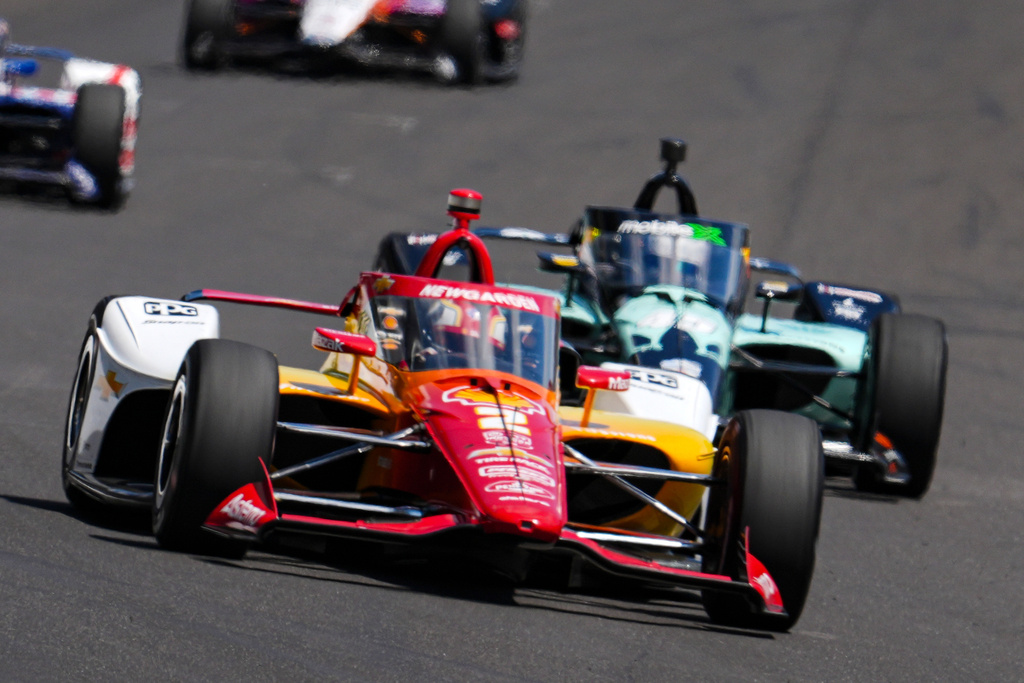
A key point about the four-turn oval is the two long straightaways that span five-eighths of a mile. Here’s a basic image of what the track looks like.
Printable IMS map, driving directions and Indy 500 road closures https://t.co/fzUHerxtL0
— IndyStarSports (@IndyStarSports) May 15, 2026
The best way to describe the Indy 500 track is “a rounded rectangle.” Wide-angle pictures better capture the 9.2 degrees of banking in each turn. However, wind and weather can often play their own tricks. Coming off the chutes well becomes essential later in the race to carry momentum.
Getting well off Turn 1 sounds like something from Formula 1. However, at the Indy 500, a driver typically has to do this for as many of the 200 laps as possible.
The wind, potentially slower cars, and an infamous "hump" can create their own havoc at around 230 mph. Don’t sleep on Turn 3, either, as coming off the backstretch has its own dangers.
Most IndyCar races are raced at a lap distance of 1 to 1.33 miles at a maximum on ovals. Differences between a four-lap run as opposed to, say, a 30-35 lap window are drastic. The repetition and distance only add to the difficulty.
Oval tracks like Phoenix, the Milwaukee Mile, and even Nashville pale in comparison to the speed and acceleration found at Indianapolis Motor Speedway. These drivers don’t run 500 miles like this any other time of year.
This leads right into race strategy.
Make Indy 500 race predictions on PrizePicks — including starting and finishing position.
{{f1_offer_banner="/style-system/ui-components-playbook"}}
Indy 500 Race Strategy Explained
There are four components of note in race strategy for the Indy 500.
- Mastering the tow (aerodynamic slipstream)
- Fuel strategy (32-35 lap target)
- Tire management/pit stops
- Maximizing full-course cautions
There is a fifth component, but that comes at the end.
Mastering the Tow
Drivers deliberately try not to lead the Indy 500. This sounds counterproductive, but think of the leading car absorbing all the dirty air and having its tires often wear faster while out front.
Staying around third to eighth conserves fuel and keeps tire wear to a minimum. This is especially essential during the first half of the race.
Avoiding understeer is important, too. One wrong move puts a driver into the wall (and potentially other drivers, too). Track conditions stemming from the weather can affect this tow — slipstream — at any time.
Fuel Strategy
Conserving fuel is essential. A typical Indy car holds 18.5 gallons, which means it burns a hair more than half a gallon per lap under ideal green-flag conditions.
Drivers will often lift off the throttle during runs and brake early to stretch out their fuel window. Some will even adjust cockpit fuel maps.
This all depends on how many yellow flags there are. Fewer cautions often lead to taking fewer risks. There are always some drivers who will take the chance at a hopeful yellow flag, though.
Tire Management & Pit Stops
A race can be won or lost here as well. Pit stops are vital, along with communication between the driver and the pit crew.
Most of the time, there will be a typical four-tire change (Firehawk Firestone tires), but sometimes crews will risk going for a two-tire right-side change to save a few seconds.
Handling and adjustment issues can be plenty or few during a 200-lap race like the Indy 500. Drivers can make changes while on their run, or the pit can make changes during stops.
Hoping for Full-Course Yellows
So many things are going on during an Indy 500 race. Typically, most drivers pit under yellows, but others will stay out trying to gain track position, leading to a chess match of sorts. Drivers are hoping for more full-course cautions.
On average, there are 7-8 caution periods. More incidents tend to happen during the first half of the race. Randomness can also play a role at Indianapolis more than at other tracks. Speaking of which…
Accounting for Variance
While timing is essential, there is an aspect that is largely out of one’s control. Pato O’Ward explained it as such.
"There's so many things that are out of your control that can throw it upside down,” Ward said this week. “But at the end of the day, it is up to us inside of the race cars to try and just get ourselves into that opportunity to make it happen."
Plot twists at the Indy 500 are common and almost inevitable. Nothing ever goes truly according to plan. From cautions to drivers unexpectedly running out of fuel, anything can happen at Indianapolis.
The weather falls under the same umbrella — pun intended. Look at last Saturday as evidence.
Make Indy 500 Picks on PrizePicks
The Indy 500 offers quite a few ways to get into the action. Don’t wait until the green flag drops on Sunday afternoon — make your Indy 500 picks on PrizePicks now and earn real money if you’re right.
Pick racers, predict More or Less on their stats, and cash in if you’re right. With Team Picks, you can make predictions on finishing position, podium, and winning the race, now available in 35 states.
Keep a watching eye on the Playbook for IndyCar predictions, picks, and news all the way into Sunday.
Team Picks and Culture Picks are event contracts offered by Performance Predictions II, LLC d/b/a PrizePicks Predict, a CFTC-registered FCM and NFA Member. All event contract customers must be U.S. residents and 18+. Some event contracts may not be available in every state.Event contract trading carries significant risk and is not appropriate for everyone. No guarantee against loss is offered. Past results are not necessarily indicative of future results.Void where prohibited by law. Restrictions apply. For full terms of service see prizepicks.com/predict-regulatory. Team and Culture Pick Early Payouts subject to market liquidity. The content provided is for informational and educational purposes only and does not constitute investment advice, or a recommendation to trade any commodity interest.


.jpg)